Master the Art of Crocheting with This Step-by-Step Guide to a Basic Granny Square

Crocheting a granny square is one of the most rewarding and accessible projects for beginners and experienced crafters alike. This classic pattern forms the foundation for countless blankets, scarves, bags, and other handmade treasures. If you have ever wanted to learn how to crochet or expand your skills, mastering the basic granny square is a perfect place to start. This guide will walk you through every step for a beginner, from choosing your materials to finishing your square with neat edges.
Whether you want to create colorful patchwork projects or simply enjoy the relaxing rhythm of crochet, this tutorial will give you clear instructions and helpful tips to succeed.
What You Need to Get Started
Before you begin crocheting your granny square, gather the following materials:
Yarn: Choose a medium-weight yarn (also called worsted weight or category 4). Acrylic or cotton yarns work well for beginners.
Crochet hook: A size H/8 (5 mm) hook is a good match for medium-weight yarn.
Scissors: For cutting yarn.
Tapestry needle: To weave in ends after finishing.
Measuring tape or ruler: Optional, to check your square size.
Selecting the right yarn and hook size ensures your stitches are even and your square holds its shape. Avoid yarns that are too thin or too thick for your hook, as this can make crocheting harder. You can refer to the label on your yarn. It usually has recommendations on hook size and even gauge!
Understanding Basic Crochet Terms and Stitches
Before starting the granny square, it helps to know a few basic crochet terms and stitches:
Chain (ch): A simple loop stitch that forms the foundation.
Slip stitch (sl st): Used to join rounds or move yarn without adding height.
Double crochet (dc): A taller stitch that creates the open, lacy look of granny squares.
Round: A complete circle or square of stitches worked before moving to the next layer.
If you are new to these stitches, consider practicing them separately first. Many online videos and tutorials can help you get comfortable with chaining, double crochet, and slip stitches.
Classic Granny Square Pattern
This pattern creates a solid, traditional granny square. It is written using US crochet terminology.
Pattern Details
Skill Level: Beginner
Finished Size: Varies by yarn (approx. 4 inches / 10 cm with worsted weight).
Gauge: Not critical.
Materials
Yarn: Any weight yarn (Worsted/Aran weight is easiest for learning).
Hook: Corresponding hook size (usually H/8 5.0mm or I/9 5.5mm for worsted).
Notions: Tapestry needle, scissors.
Abbreviations (US Terms)
ch = chain
sl st = slip stitch
dc = double crochet
sp = space
st = stitch
Instructions
Starting the Square
You can start in one of two ways:
Magic Ring: Make a magic adjustable ring (creates a tighter center and my favorite method!).
Chain 4: Ch 4, then sl st into the first ch to form a ring.
Round 1: The Center
Ch 3 (counts as your first dc).
Work 2 dc into the ring (this completes the first "cluster" of 3).
Ch 2 (this forms the first corner).
Work 3 dc into the ring.
Ch 2 (second corner).
Work 3 dc into the ring.
Ch 2 (third corner).
Work 3 dc into the ring.
Ch 2 (fourth corner).
Sl st to the top of the beginning Ch 3 to join.
Total: 4 clusters of 3-dc, separated by 4 corner spaces.

Round 2: Growing the Square
Sl st into the next 2 stitches, then sl st into the corner space. (This moves your hook to the corner to start fresh).
Ch 3 (counts as first dc).
In the same corner space, work: 2 dc, ch 2, 3 dc. (First corner completed).
Ch 1.
Skip the 3 dc from the previous row.
In the next corner space, work: 3 dc, ch 2, 3 dc.
Ch 1.
Repeat step 6 and 7 for the remaining corners.
Sl st to the top of the beginning Ch 3 to join.

Round 3: Adding Sides
Sl st across to the first corner space.
Ch 3 (counts as first dc).
In the corner space, work: 2 dc, ch 2, 3 dc.
Ch the next space (the side space formed by the ch-1 from the previous round), work: 3 dc.
In the next corner space, work: 3 dc, ch 2, 3 dc.
Repeat the pattern around:
Corners: (3 dc, ch 2, 3 dc) + ch 1
Sides: 3 dc + ch 1
Sl st to join.

Continuing Larger
Repeat Round 3 for as many rounds as you like.
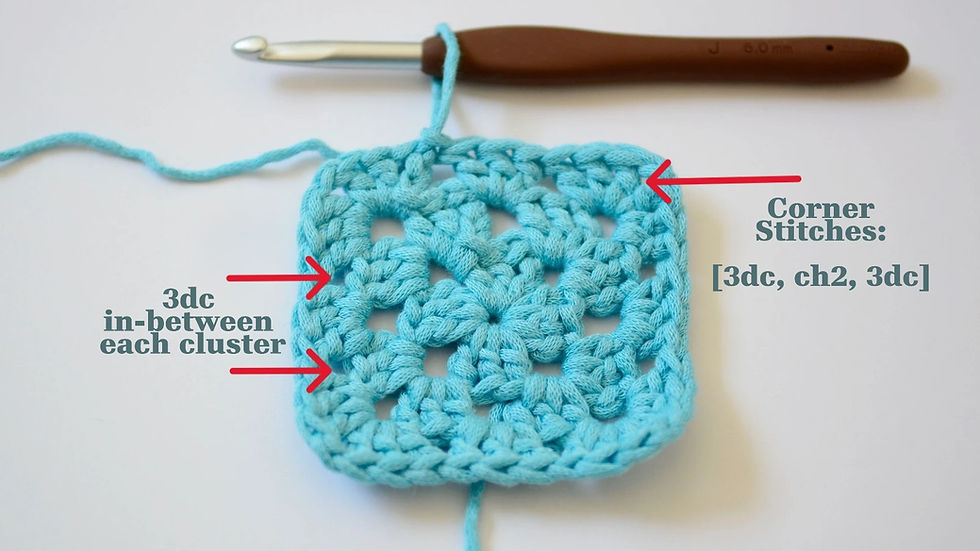
Corners: Always work (3 dc, ch 2, 3 dc) in corner spaces.
Sides: Always work 3 dc in the side spaces

Finishing
Cut the yarn, leaving a 6-inch tail. Pull the tail through the loop on your hook to fasten off. Weave in the ends with your tapestry needle.
Tips for Perfect Granny Squares
Keep your tension even. Try not to pull the yarn too tight or leave it too loose. This will take practice, so don't give up!
Count your stitches. This helps maintain the square shape. Frogging (pulling it apart) to fix it is no fun!
Use stitch markers. Place markers in corners to easily identify where to work clusters.
Block your squares. Lightly wet and pin your squares to shape them evenly before assembling projects. You can use a spray bottle.
Experiment with colors. Change yarn colors at the start of a new round for vibrant patterns.

How to Use Your Granny Squares
Once you have mastered the basic granny square, you can create many projects:
Blankets and throws: Join multiple squares for cozy, handmade covers.
Scarves and shawls: Connect squares in a row or pattern.
Bags and purses: Sew squares together for unique accessories.
Home decor: Use squares for pillows, table runners, or wall hangings.
Joining granny squares can be done by sewing or crocheting them together. Try different joining methods to find what you like best. Here's a method you might find fits your needs, but again, a quick search on YouTube and you will find dozens of videos on joining Granny Squares.
Troubleshooting Common Issues
Square edges curling: Check your tension and make sure you are working the correct number of stitches in corners.
Uneven sides: Count stitches carefully and use stitch markers.
Holes too large or small: Adjust your hook size or yarn weight.
Difficulty joining rounds: Practice slip stitches and ensure you join at the correct stitch.
Patience and practice will improve your skills quickly.
Reading Crochet Patterns and Charts is also an important skill to learn. It may seem intimidating at first, but trust me, it opens a door to so much more! Below is a chart of the granny square (in different colors). Below the image is a legend of what each symbol means.


Check out some of my "Granny" Patterns (not all of them are traditional squares).
Learn how to crochet other Granny Square:


For Designs by Phanessa patterns, visit my shop.
You may sell products using my patterns, but please give credit and link back to original designer & the patterns. Do NOT use any of my photos or copy/distribute any of my patterns as your own. If you share my free patterns, please link back to original pattern page. Please leave a comment if there are errors to any of my patterns. Thank you!
© 2026 Designs by Phanessa, All rights reserved.
PRIVACY and DISCLOSURE:
Designs by Phanessa is a participant in multiple affiliate programs that provide an advertising commission if you purchase through these links. If you purchase something from the affiliate links, I will get a small commission at no extra cost to you. I DO NOT collect, store, use, or share any data about you.
Transparency Note on AI Use
I believe in sharing my creative process. This pattern and all accompanying content were originally developed by me, a human crocheter. I used Gemini, an AI large language model, in a supporting role to assist with brainstorming ideas and polishing the descriptive text of this blog post. All stitch counts, row instructions, and finished product photos are the result of my own original design and manual effort.


I like the section about preparing artwork before ordering. A Custom Embroidered Patches lot of people probably overlook that step.
https://32win.marketing/ vô tình lọt vào mắt mình khi đang xem một video hướng dẫn quản lý bộ nhớ trên điện thoại. Sau khi đọc thêm phần thông tin bên dưới, mình thấy tên này xuất hiện trong một nguồn liên quan nên tò mò mở thử. Mình không tìm hiểu sâu mà chủ yếu xem giao diện và cách nội dung được sắp xếp. Phần đầu trang khá thoáng, tiêu đề dễ nhận ra và các khối thông tin được tách tương đối rõ. Mình lướt trên điện thoại vài phút, kéo xuống khá mượt rồi đóng lại. Trải nghiệm ban đầu nhìn chung khá dễ chịu.
Trong lúc lướt mạng, mình bắt gặp NK88 xuất hiện trong một vài bài chia sẻ nên tò mò mở thử. Mình không có ý định xem hết mọi thứ trên trang, chỉ kéo qua từng đoạn để xem giao diện được làm theo kiểu nào. Nhìn chung các khu vực không bị xếp quá sát nhau, có khoảng trống vừa phải nên nhìn lâu cũng không thấy ngợp. Những phần khác nhau được gom thành từng khối riêng, muốn tìm một khu vực cụ thể thì nhìn qua cũng khá dễ nhận biết. Thanh menu cũng được đặt khá rõ ràng nên việc chuyển sang mục khác tương đối nhanh. Mình chỉ xem một vòng ngắn nhưng thấy bố cục…
Mình không có thói quen chơi quá lâu, thường chỉ lúc rảnh mới vào xem vài game để thư giãn. Gần đây mình thử qua 8xbet, ban đầu chỉ định lướt xem giao diện nhưng thấy các mục được sắp xếp khá rõ nên cũng chơi thử vài ván. Tốc độ tải ổn, lúc chuyển từ game này sang game khác không phải chờ lâu. Mình thích kiểu bố trí đơn giản như vậy vì không cần mất thời gian tìm kiếm. Nhìn chung trải nghiệm khá nhẹ nhàng, hợp với mình khi chỉ muốn vào chơi nhanh một lúc rồi nghỉ.
Sau khi thấy một vài người chia sẻ, mình cũng vào https://8xbetsh.com/ xem qua để tham khảo cách họ làm giao diện và phân chia chuyên mục. Cảm nhận ban đầu là trang web trình bày rất mạch lạc, bố cục cân đối và chia khu vực rõ ràng nên nhìn rất thoáng mắt. Thanh điều hướng cũng được làm trực quan, hiển thị đủ danh mục nên việc thao tác hay chuyển đổi giữa các phần nội dung cực kỳ nhanh chóng và thuận tiện.